01
Single-tooth implant
An implant can replace a missing tooth root and support a custom crown without preparing adjacent teeth. Suitability depends on bone, gum health, available space, bite forces and medical history.
NORTH ARBOR DENTAL · KITCHENER–WATERLOO
Dental implants can replace one tooth, several teeth, or support a full-arch restoration. At North Arbor Dental, general dentist Dr. Reza Roodsar evaluates your oral health, available bone, medical history and restorative goals before discussing whether implant treatment is appropriate.

A CLOSER LOOK
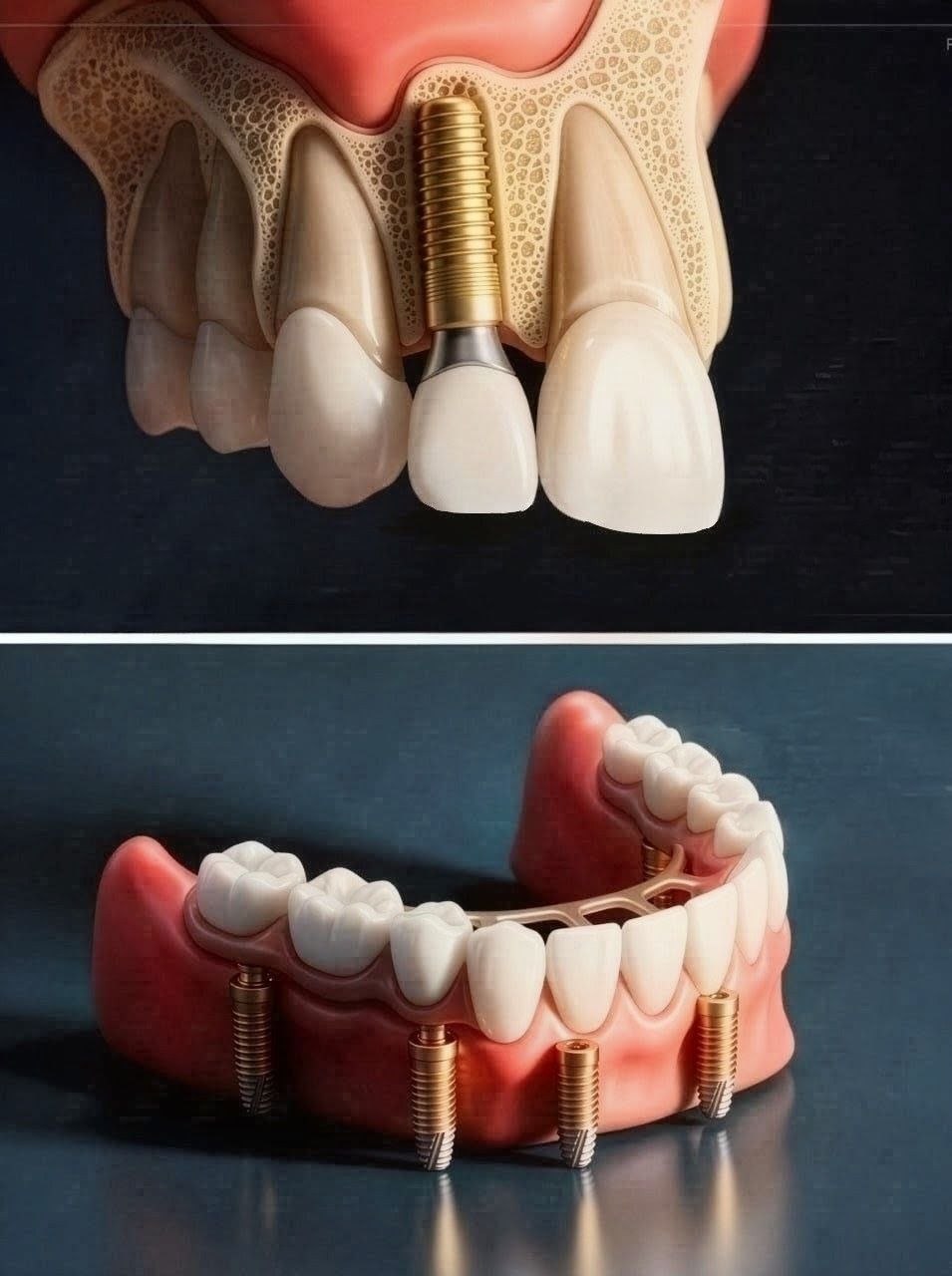
Implant treatment is planned around what is missing, the condition of the remaining teeth and gums, available bone, your bite, and the type of restoration you need.
A dental implant may support a crown when one tooth is missing.
Implants may support a bridge, removable overdenture, or fixed full-arch restoration.
UNDERSTANDING YOUR OPTIONS
01
An implant can replace a missing tooth root and support a custom crown without preparing adjacent teeth. Suitability depends on bone, gum health, available space, bite forces and medical history.
02
When several teeth are missing, implants may support a bridge or help stabilize a removable prosthesis. The number and position of implants depend on anatomy and restorative design.
03
For a failing or fully missing arch, implant-supported options may be fixed or removable. All-on-X is one fixed full-arch approach; implant-supported dentures are another.
FROM CONSULTATION TO FOLLOW-UP
01
We review your medical and dental history, examine the mouth, and use scans and dental imaging when indicated to assess the site, bone and surrounding anatomy.
02
We plan the restoration first, then determine implant position, timing, and whether extraction, bone grafting or other preparatory treatment may be needed.
03
One or more implants are placed according to the treatment plan. Guided surgery or immediate placement may be considered when clinical conditions support it.
04
After appropriate healing and reassessment, the implant is restored with the planned crown, bridge, denture or full-arch prosthesis. Ongoing hygiene and professional maintenance remain important.
INFORMATION FOR YOUR DECISION
Care is provided by general dentists. Your clinical assessment guides treatment recommendations.
A dental implant is a small metal post placed in the jaw to support a dental restoration. Depending on the situation, it may support a crown, bridge, removable overdenture or fixed full-arch prosthesis.
Assessment considers gum health, available bone, medical history, smoking, bite forces and the ability to maintain oral hygiene. Some patients need additional treatment before implant placement; others may be better served by a different option.
Not everyone does. Grafting may be recommended when available bone is insufficient for the planned implant position or restoration. The need, type and timing are determined after examination and appropriate imaging.
Sometimes. Immediate implant placement depends on the condition of the socket, infection, bone and gum anatomy, primary stability and the restorative plan. Delayed placement may be more appropriate in other situations.
Risks include infection, failure to integrate, injury to nearby structures, gum or bone changes, and loosening or damage to restorative components. Daily cleaning, regular reviews and professional maintenance remain necessary.
Cost depends on the number and location of implants, imaging, extractions or grafting, the type of restoration and laboratory or prosthetic work. A written estimate is provided after assessment so you can see what is included.
Further reading: Canadian Dental Association: Dental Implants. Meet our dental team.